Tuesday, September 01, 2020

2.8 Lakh Crore Worth Residential Projects Stuck in COVID-19

We expect stranded inventory worth Rs2.8 tn [2.8 Lakh Crore] to put debt worth Rs1.2 tn (28% of total real estate loans in India) at risk. Adverse market dynamics and regulatory factors have strained the real estate sector over the past five years, leading to increased capital requirements and diluting return profiles, and in turn plunging ratings of around one-third developers to below investment grade. Covid-19 induced disruptions have dealt another crushing blow.

Real Estate Developer loans nearly doubled to Rs4.2 tn over the past five years. Buoyed by easy access to funding, NBFCs/HFCs aggressively captured this financing demand. Despite severe headwinds for the real estate sector putting about 28% of the loan book at risk, most wholesale NBFCs/HFCs have not reported any significant NPLs as a large proportion (40%) of the real estate book is under moratorium. However, rating-wise breakup of loans sanctioned exposes the poor underlying asset quality.

We estimate the real estate sector would need immediate capital infusion of Rs390-650 bn. While the recent (August 6)window provided by RBI for restructuring will augur well, long-pending NPL recognition of unviable stressed projects is crucial. Recognition of inter-creditor agreement under IBC to provide flexibility in structuring last mile funding.

We can’t quantify the impact on the real estate sector and its lenders, however a wave of consolidation in the sector is imminent. Asset quality challenges for new real estate lending players, now accentuated by higher NPL recognition, coupled with debt market consolidation will lead to the real estate lending business being consolidated with banks and select NBFCs.



Monday, August 31, 2020

Accountablity Slowed Down BlackMoney Dominated Realty

The past few years have been the worst for India’s real estate market, constrained by the implementation of RERA, GST and demonetization ebcause the sector was largely under the influence of corrupt politicians, bureaucrats and tax evading business houses.

Household income has increased at ~10% CAGR over the past three years, while residential real estate prices have increased by less than 1%, thus signifying improving affordability. However, investor interest has reduced due to declining capital appreciation, which remains a challenge.

FDI has almost doubled over the past five years, with inflows increasing primarily towards commercial projects. Interest by foreign players like Blackstone, Canadian Pension Fund has increased considerably in the past five years or so. 

India’s office space has more than doubled in the past decade to 550 mn sq ft. This is still far less than the developed markets, thus signifying considerable future potential. There is increased interest from foreign players to rent office spaces in India, with US having the highest proportion at 44% of total office space acquired in India. Within this, 39% is occupied by IT/ITeS sector, 12% by manufacturing, 13% by BFSI and 10% comprising shared working spaces.

India’s warehousing absorption has tripled over the past three years to ~32 mn sq. ft. in FY2018 from ~10 mn sq. ft. in FY2015 with the quantum of Grade A projects almost quadrupled. Also, vacancy levels have dropped below 10%, thus signifying an improving market scenario.


Real Estate in COVID-19 - Slow but not Out

Residential sales for listed developers were down 35% YoY; most reported ~50- 60% YoY decline, except GPL (+70% YoY). Seamless adoption of online booking systems, higher share of NRI sales, and demand for larger homes helped. Collections saw a sharper decline, down 50% YoY, owing to lower construction activity and deferral of demand letters, although lower outflow on construction spend/overheads aided operating cash flows and debt levels. The momentum has improved since July, especially in new bookings, where the outlook on recovery is better than collections/operating cash flows.

Rental collections for Office have been >95% for 1QFY21, with broadly stable occupancy levels and most developers witnessing no material rental re-negotiations. The capex outlook was largely restored across developers, as commentary suggests that the LT demand outlook remains intact and supply from smaller players is likely to falter on lack of funding. Near-term leasing outlook is tepid due to the ongoing lockdown, marginal increase in vacancy levels and muted escalations in rentals are likely for FY21  

Mall developers offered rental waivers (minimum guarantee rental) − ranging over 50-100% − to tenants, for 1QFY21 (lockdown period). Mall owners are also likely to offer graded waivers over a large part of FY21, till business is back to normalcy. Footfalls across malls remain weak, with Bangalore malls reporting just 20-25% footfalls, and overall pan India retail sales down 63% YoY in July (Source: RAI). The hospitality portfolio for most developers reported low-to-nil occupancy (due to the shutdowns) and losses at the Ebitda level. Mall owners expect sales to improve by 3Q during the festive season and with the opening of Multiplexes / Dining, although a full recovery may still be some quarters away.

Realty Developers are sanguine on a recovery in 2Q, and are lining up new launches in 3QFY21, by when labour availability is also expected to reach pre-Covid levels.

Monday, July 03, 2017

Housing for All by 2022

Volume growth is the key growth driver this decade, versus Asset Price Appreciation in the previous decade.

The government's efforts towards Housing for All by 2022 implies multifold increase in supply, which is yet not visible. Cement demand is a good leading indicator for the property sector, according to the panelists.
Demand for completed projects is high due to low execution risk. In the past few quarters, there has been an increase in interest in lower ticket size apartments.

Affordable housing has significant underlying demand (and hence a big opportunity for developers). Plus, multiple incentives announced by the government have resulted in many prominent developers entering this space.

Most of the states are yet to notify RERA rules despite the set deadline of July 30, 2017. Grade A
developers are likely to benefit from RERA due to their stable balance sheet (ability to comply with 70% escrow requirement), good execution capability and better corporate capability to comply with new rules.

Tuesday, June 27, 2017

Residential Real Estate - Affordability alltime high now

With property prices rangebound / downward across major markets, improving incomes + reduced mortgage rates have improved affordability levels to 10+ year highs. Mortgage rates are now near seven year lows. Historically, whenever mortgages have come close to the 8% mark (vs currently at 8.5%), residential markets have seen a significant boost upwards. Customer confidence on end delivery is lacking and we think once RERA comes in that will get addressed over a 23 year view.

 The latest data points from various primary market sources (Prop equity / JLL) show that unsold inventory across markets has started to come down. This data point was consistently trending up since 2009 and hence we believe a reduction marks a seminal change. Further, new launches falling off 50-80% across markets and the structure of deliveries showing large declines from 2018 onwards implies that market supply is going to be challenged from 2018/19 onwards, in our view. As the RERA bill comes through this unsold supply number we think will have even higher downside risks as we expect many new projects to be simply cancelled as many developers find the economics unviable.

Looking at private market actions, we think the private investor focus is moving into residential real estate either via credit/equity strategy and fund flows have increased. Also reflected in increased lending appetite in many NBFCs as well. Further many other senior long cycle executives/ leaders in the business we note too have quit to start owned ventures in the residential realty business.

Friday, June 16, 2017

RERA registrations in Mumbai Sluggish

As of June 15, 2017, only 16 Mumbai projects (plus 4 in Thane; 32 overall Maharashtra) are displayed as registered on the Maharashtra RERA website, which we believe are those approved by the regulator. While there is likelihood that more projects may have been registered but not approved as yet (hence not displayed), total approvals appear quite low versus the quantum of ongoing projects—800 plus, we estimate. In our view, the poor registration statistics could be due to developers taking time to understand process details and aligning their internal processes with RERA's provisions.

Channel checks with GPL, Oberoi and SRL (exposed to Mumbai residential market) indicate that they are in an advanced stage of background preparation for registering their projects under Maharashtra RERA. This, according to them, is a time consuming process and are seeking expert guidance to adhere to the regulations. They expect to begin the registration process over coming weeks and are confident of meeting the July 31 deadline; they do not anticipate any disruption in their project sales. Failure to meet the deadline will prevent them from advertising & selling unregistered projects.

In view of the poor registration momentum in Mumbai, we see risk of a meaningful proportion of ongoing projects remaining unregistered at the end of the deadline. New launches in Mumbai have slowed down pending RERA registration and we expect this to continue for coming few months until developers align themselves with RERA requirements. We, hence, expect new sales to slowdown in the Mumbai market post the deadline, with steady recovery in ensuing months as registration of ongoing projects and new launches pick up.

Sunday, March 26, 2017

Govt Housing Benefits only for Low Income Groups

The credit-linked subsidy scheme (CLSS) under the Prime Minister Awas Yojana (PMAY) will help reduce the IRR on home loans by about 100 bps or imply 2-10% discount on purchase of new property, higher benefit at lower ticket sizes. The scheme alone may not be a catalyst for making a purchase decision; better employment opportunities and improving affordability will have to play a greater role, in our view.

The MIG segment will be included in this scheme from FY2018 to provide the following: (1) 4% subsidy for loans up to Rs0.9 mn and (2) 3% for loans up to Rs1.2 mn. Interest subsidy is credited upfront to the loan account of beneficiaries through lending institutions (banks/HFCs) resulting in reduced effective loan liability. The calculated subsidy for loans across categories is Rs0.23 mn. This benefit is only available to first-time buyers.

The CLSS for the MIG saves around 5-8% on Rs3-4 mn/unit home. With increasing ticket size, the impact of such subsidy reduces. While household income cap of Rs1.8 mn/annum can allow homes between Rs7-9 mn/unit, the benefits of the subsidy don’t stand much (about 3%).

 Most units offered by listed developers in metros are above Rs5 mn/unit and hence the benefits of such schemes are limited. We expect more developers to launch homes up to 60 sq. m. carpet in FY2018 (to gain benefits under 80-IBA), which could increase volumes; but value contribution will be limited considering the share of such units to the overall area under-construction. Most developers under coverage offer limited affordable housing homes today.  

CLSS is most beneficial for borrowers in loan of about Rs2 mn A high income cap provides relief to a large proportion of borrowers though, at the higherend would imply just about 3% benefit. The implied discount is meaningful at 5-8% in case of loan of Rs2-3 mn, which comprises about 25% of total loans of housing finance companies. With increasing ticket size, the impact of such subsidy reduces; it's about 3% in the higher-end.

Friday, February 03, 2017

Investment / Speculation Made Less Attractive in realty - Budget 2017

Real Estate investors / speculators in India historically benefitted from full offset available on house property income loss (property rent -  home loan interest). However budget 2017 has capped the loss offset to Rs 0.2mn inline with self-occupied interest exemption.

Based on our analysis, the move increases funding cost by 30% with investors return lowering by 3-5% in the first year. In addition clause introduced on reducing holding period for long term capital gains from 3 to 2 years will reduce the exit cost for investors.

We believe these provision will significantly impact investor demand (already declining) and increase supply in secondary market as house economics worsen materially (4% capital appreciation required to break even) leading to headwind on property pricing. For completed unsold apartments, developers have been given an year’s exemption for tax on notional rentals.

Affordable Housing Darling of Government
Government gave infrastructure status to affordable housing which will result in better access to funding (including land funding), longer tenure loans and lower cost of funding. In addition tax incentives for affordable projects were made inline with practice as 1) size definition changed from built up to carpet.  2) period of completion of project for claiming deduction increased from existing 3 years to 5 years (more realistic timeline in our view). We expect more players to focus on this segment as these clauses could improve return profile by 15-20%.

Wednesday, December 28, 2016

Market slowing down, managing repayments and construction the key

The Real Estate market has slowed after showing steady trends for two years on volumes. In Bangalore too, local issues drove negative sentiment, but organized developers held on to their volumes. Gurgaon remains an aberration for large developers as well - sales remain weak. We expect launches to drop further as developers look to sell from ongoing projects. We don’t expect new launches form listed developers in Mumbai and Gurgaon over next two-three quarters, while Bangalore might report launches in certain pockets.

Any potential fall in pricing is unlikely to boost volumes as sales usually don’t pick up in a falling price environment. But we don’t expect a major correction in pricing in the western and southern metros as prices have remained stagnant for the past three years and affordability has been improving in certain markets. Transaction prices are usually 80-85% of the quoted prices for the past three years and could see some discounts / offers.

Slower volumes worry us more than drop in pricing, as lower volumes will reflect in lower collections resulting in slowing construction and servicing of liabilities. Market-wide volumes could correct over the next 2-3 quarters, by 10-30%. This will delay projects of several unorganized developers further, as availability of credit is limited to organized developers.

Tuesday, December 20, 2016

Real Estate Industry in India - Shift towards Transparency

Real estate industry is at a cusp and there is clear shift that is happening for positive in the long term.

Looking ahead, there is a tectonic change that is going to happen to the industry, for which we feel that the next three to five years are going to be a different scenario for the real estate space in India. The Real Estate (Regulation and Development) Act, 2016 (RERA) coming into place, is a historic event in itself, an era whereby the industry is going to get institutionalized, which will make it consumer friendly along with enhanced transparency. The Benami Transactions (Prohibition) Amendment Act (PBPT) will ensure that undeclared money which was chasing the real estate industry will be impacted. Third is the Land Act
which is currently under discussion, and is long drawn, but when it happens and whatever time frame it takes, will eventually give a huge supply to the industry.

With consumers becoming more technology savvy, the online real estate platforms are pushing the industry
towards a consumer‐driven market. In the downward interest rate regime, we have already seen rates coming down from 11% to 9 % and the anticipation of another percentage drop seems perfectly plausible.

India can’t be much different from any other country. REITs as an assets class is the requirement of specific set of investors for long term; these investors look for a mix of both ‐ regular returns and a reasonable level of capital appreciation. Majority of the foreign capital in last 3 years has been pumped into the commercial real estate space to lock Grade‐A space.

All markets move in cycles, and the real estate market is no exception, where we have already witnessed the down turn. Post 2008 and more so post 2010, we have seen a general uptick for the industry followed by another bout of sales slowdown, untimely deliverables. A correction phase began almost three years ago, in the residential space, while the market almost bottomed out in the commercial space.

Real estate being a cyclical industry, we should consider investing with a long term horizon of 5‐6 years, and going forward we see better returns than other asset class. We feel this is the correct time to be in the sector, when you have all the regulations coming into place, with expected inflows of institutional capital in the sector, a low interest rate regime, backed by a robust and growing Indian economy.

Excerpts from Aditya Birla Real Estate Fund CEO M. Yadav

Monday, December 19, 2016

Real Estate Price Correction Inevitable for Industry Sustainability

The Indian real-estate demand will fall meaningfully as lack of currency slows down the black economy: NIPFP estimates black money is 40% of real-estate demand. Real-estate as the favoured repository of black wealth is the reason India’s rental yields are the lowest among major economies despite high interest rates.

Given its large contribution to GDP globally, falling real-estate prices have either accompanied or driven a recession. India may also see a sharp slowdown, as first slowing transactions and then falling prices affect construction. Falling prices would thus affect discretionary consumption as well as borrower health, with its own downstream implications.

Like many other effects of demonetisation, falling real-estate prices for India can help the economy over two to three years. India needs more housing stock, and its construction can boost output and create jobs: this was stalled by high clearing prices. However, for now we do not expect investors to look through the impending weakness, particularly as the slowdown in demand could be protracted by a buyers' strike. Eventually when prices have corrected by, say, 20% and mortgage rates have fallen by, say 2 percent points (implying EMIs fall by ~15%), the cost of ownership could actually be down by nearly ~35%.

Friday, November 18, 2016

BlackMoney Real Estate - End of an Era

We Congratulate the Narendra Modi Government for taking the boldest step to eradicate the nuisance of Real Estate mafia with Corrupt & BlackMoney in the Mainstream Economy of India.

Investments in Real Estate and gold would be the most impacted as these asset classes were the favourites to park unaccounted cash savings. Home improvement stories may also face collateral damage as the real estate sector goes through another leg of downturn.

Demonetisation of higher denomination Indian rupee notes Rs 500 & Rs 1000 mostly held by Corrupt Bureaucrats and Politicians will reduce land transactions and asset values in general, specifically in tier 2/3 towns and cities, where the proportion of unaccounted money in transactions is higher.


Curbs on the use of high denomination notes is likely to hit land transactions hard especially in the NCR region and tier 2/3 towns in India. Investor demand is generally the highest in the NCR region and thus it should be hit the hardest. We think a recovery in the NCR / Mumbia Metro Region property market will be delayed further.

Near-term sales velocity should decline due to uncertainty. Developers with higher reliance on plotted sales could see more slowdown compared to the ones selling flats. The unorganised segment (with lower tax compliance) of Indian real estate will be more hit than the organised one. Similarly, we expect more slowdown in the secondary market, versus primary sales, owing a higher proportion of cash transactions. This could lead to some slowdown in primary sales especially from the buyers that look to upgrade by selling old houses and buying new ones.

We think the discount to NAV in the India real estate sector is likely to increase as sales velocity could come down in the short term.

First Time Home Buyers
Be prepared with 25% Down Payment Cash and rest for Housing Loans. You will get your dream home cheaper, at least 20% discount to prevailing prices before demonetization.

Monday, October 17, 2016

Mumbai Residential Wait for market equilibrium continues

MMR real estate market witnessed a marginal increase (4%) in pricing over last year, based on our visit to developers in the exhibition. More than 50% projects in our survey had a delivery schedule in FY17 and FY18 while 30% should be available for delivery in less than a year (Exhibit 1). Handover has been delayed by 6 months on an average over last one year.

Developers are using discounting in the form of subvention schemes, stamp duty/floor rise/maintenance bill waiver and freebies (furniture, gold coins, and holiday trips) to improve sales velocity. However, bulk of these discounts offset the marginal price increase taken by the developers. We continued to observe higher discounts available on execution of deal (10-15%) which remains a preferred way of giving discounts than cut in declared property rate.

We observed higher participation by housing finance companies (HFCs) which were offering home loans starting from 9.3%. However the latest RBI rate cut was not yet incorporated in the rates offered. In addition HFCs were funding upto 100% of contract value if market value exceeded contracted value. Approval process timelines varied from 5 to 15 days. First half of FY17 has seen improved funding from banks to developers (10% YoY in Aug’16) as NBFCs continued to gain market share in the sector (1QFY17 growth at 25-30% YoY

With sales exceeding launches over last 6 quarters, market is in a self-correcting phase. This process could be accelerated by improving affordability- higher disposable income or price correction. However with high under construction inventory, we expect capital value improvement to take 12-24 months. Improving transparency (Real Estate Regulator) will improve the customer confidence thus aiding in recovery.

Saturday, October 01, 2016

REIT listings finally to come true in India

Recent media articles have quoted promoters /senior management of developers /sponsors putting a timeline for listing their rental portfolios. Our channel checks suggest some sponsors have started working towards filings with the regulator. Government has cleared many impending issues, mainly on taxation and what remain are state (local) subjects.

SEBI has allowed the REIT to invest in a two level SPV structure. This will save taxes at multiple levels as many assets are held in different SPVs, with different structures. This is beneficial for most of the developers. Allowing REITs to invest up to 20% in under-construction assets (from 10% earlier). Such a change will help bringing more assets under the REIT and also a possible increase in the yield as under-construction /un-leased area is usually brought at lower prices than a rent yielding asset.

Amending the definition of valuer. We believe Independent Property Consultants (IPCs) and real estate valuers will be included as not all practicing Chartered Accountants have the ability to provide fair value to real estate properties.Clarifying the definition of ‘real estate property’: The proposal was to include other rent generating assets like hotels, hospitals, warehouses etc., which otherwise are classified as infrastructure assets. Such inclusions will bring many more assets under the REIT.

Removing the limit of sponsors (currently up to 3) and introducing the concept of sponsor group. While developer sponsors won’t be affected by this; it could be beneficial for private equity, conglomerates and financial institutions having REITable assets.

We expect the first set of REITs to come from three or four unlisted developers /sponsors and together could raise between USD 1.2-1.6 bn (between 75-100 mn sq. ft of rental assets will be listed).

Tuesday, August 09, 2016

JLL Views on Indian Residential Market

According to Jones Lang Lasalle - JLL, pan-India new launches have been falling steadily to now 30k units in F2Q17 and sales have stabilized at 36-38k units/quarter. Overall, projects with a good brand name and good locations are selling well, with premium pricing, like Godrej Trees (Rs18k psf ). Upcoming city markets include Chennai, Hyderabad and Ahmedabad. Also, developers are launching their projects in phases as opposed to their failed attempts at one-time launches seen three years ago.

Mumbai's eastern suburbs (GPLs Trees and OBER's Mulund) are doing better than western suburbs. Ready but unsold inventory is low – a mere 1.46% in Mumbai, 2.5% in Bangalore and ~5% on an average in other cities. Grade A companies are already RERA compliant, having financial discipline and good governance.

Pan-India residential prices have stagnated in the last two years, but are most likely to appreciate 5-6% in the next two years (inflation-linked). Mumbai based Ekta Developers recently sold its project of 700 units in Virar by offering a 20% discount (received 14,000 applications).

Commercial & Retail
Upcoming office completions will add 110msf in the next three years, wherein two-thirds of new completions will be composed of good office space having the right infrastructure, price and specifications. The remaining one third of upcoming assets will not have the same location-infra mix and hence could show high vacancy rates. Some 40% of office space is currently being leased to IT companies, and the balance of demand is being driven by pharma, consultancy and BFSI.

Top city choices include Bangalore (under 5% vacancy), followed by Pune, Hyderabad (under 10% vacancy.) and Chennai (10% vacancy.) Gurgaon prime is relatively better than Delhi and Mumbai prime markets. Due to low availability of office space in Bangalore and Hyderabad, forward contract bookings
for built-to-suit facilities have increased substantially. Central Business District is driving the office market in India due to convenient connectivity to residential areas.

Thursday, June 23, 2016

REITs & Infra Trusts: Will They Be Reality Soon?

Market regulator (SEBI) has introduced fairly comprehensive framework for introduction of REITs/Infra trusts. Further consultations are underway to smoothen out the last remaining hurdles.

Three infra developers have taken approval for formation of investment trusts. The discussion with property developers for formation of REITs is underway.

Long pending issues of taxation have been resolved. The only pending issues are 1) exemption from long-term capital gains taxes for holding period of >3 years (vs one year for equity), 2) Incidence of stamp duty at the state level, 3) tax inefficiencies when multiple level of SPVs are involved. However, most of the experts felt that remaining tax issues are not a deal-breaker and there is high chance that these issues will be resolved in near future.

Since the regulatory framework is largely in place and most tax hurdles are resolved, formation of REITs and Infra Trusts hinges on meeting of developer investor expectations. India has higher long-term bond yields compared to developed countries and it appears that investor expectations of returns are at 300- 350bps above benchmark yields.

Since unlike commercial property, infrastructure assets have finite concession periods (at the end of which asset reverts back to government), the expectations of the yield from infrastructure trusts will have to be correspondingly higher.

Thanks to efforts of regulators and tax authorities, most of hurdles have been resolved. From regulatory/tax perspectives; India is now quite close to seeing formation of initial REITs and Infrastructure investment trusts.

Tuesday, May 24, 2016

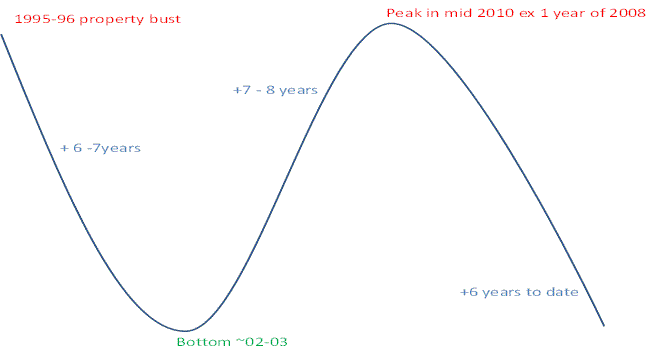
7-Year Property Cycle of India

The property cycle in India is long (7 years) and shows strength both in terms of amplitude and the length, either way. Indeed, in the past 20 years there has been one down cycle (1996-2002) wherein RE under performed most investment asset classes, notably CPI. Volume data for the same period isn’t available but evidence suggests it fell sharply. This was followed by a strong upcycle from 2003-2009 which was interfered by 1 year of GFC in 2008, thus carrying the upcycle well into in 2010. Volumes and price both went up manifold in the same period and RE probably outperformed most investment classes.

 It stands to reason that the down cycle that started in mid 2010 is now in its 6th year and 1 year likely away from its end. Strength on the downside again has been extreme with many industry veterans calling it the sharpest / most vicious down turn in history. Prices in many areas are down 10-25% and generally have underperformed CPI.

Rental yields in most markets in affordable housing are near mortgage level (on a post tax basis) – A situation that has not been there in the market since 2003. 97% of the buyers in the market are end users, suggesting investors are all but completely out (as per a Prop Tiger report).

Affordability as defined by Price to Income is one of the highest ever since 2009 across most markets- If one were to factor in the reduction in home loan rates and potentially higher tenure loans along with reduced unit sizes, the house price to mortgage payment ratio is the best since 2009.

Prices in general have lagged CPI and even general salary growth across markets over last 6 years. This likely has led to reduced investment demand but has also probably improved end user economics. We note that 1996-2003 prices also lagged inflation but made up for it in later years. Over a long cycle, property generally delivers inflation + 1-2% return

Developers incrementally aren’t buying land but forming JD / JVs to optimize capital return. Many companies that entered the market in 2006-07 are mostly out and looking to sell land. The earlier cycle has also followed some large profile near bankruptcy cases in the sector.

Saturday, April 23, 2016

Indian REITs - USD 18 bn Opportunity

With the Budget 2016-17 clearing the key hurdle of Dividend Distribution Tax (DDT), it has paved the way for REITs/ InvITs to see the light of day. We expect the 1st REIT/ InvIT listing in CY17.

As per Jones Lang LaSalle, REIT-able Grade A office space totals ~229 msf in India across 727 assets. Conservatively assuming that ~50% of this is REIT-able and an average sub-dollar rent of Rs 70/ psf, it would translate into a USD 18 bn of REIT value creation potential (based on a cap rate of 8% and an exchange rate of Rs 65/ $) Mumbai, NCR and Bangalore collectively account for 2/3rd of REIT-able assets

A number of Joint Venture (JV) platforms have been created recently between PE investors and established developers to invest in Indian commercial real estate.
  • Standard Chartered and Tata Realty & Infrastructure to create a Rs 30 bn investment platform, to buy commercial assets across the country. Standard Chartered’s share in this JV to be Rs 20 bn.
  • Goldman Sachs and Nitesh Estates announced a 74:26 JV with a commitment of Rs 18.5 bn from the former
  • Warburg Pincus and Embassy Group announced to invest USD 175 mn and USD 75 mn respectively in a JV that would focus on building warehouses across the country
With new absorptions expected to surpass new completions over the next 2 years, rentals are expected to inch upwards from current levels. Expected improvement on portfolio yields makes this an opportune time  for investors to invest in REITs

Monday, March 07, 2016

Incentives for REITs and affordable housing

The budget was positive for commercial property and affordable housing markets, key highlights being – 1) Dividend Distribution Tax (DDT) exempt in respect of distributions made by the Special Purpose Vehicle (SPV) to the Real Estate Investment Trust (REITs)/Business trust and in the hands of investors; subject to 100% ownership of the SPV; 2) 100% deduction on the profits for developing affordable housing projects for houses up to 30sq mtr (in metros) and upto 60sq mtrs (in other cities) approved during Jun'16 – Mar19 and completed within three years; with minimum alternate tax being applicable; and 3) first-time home buyers to benefit from additional interest deduction of up to Rs50,000 on loan not exceeding Rs3.5mn for a house valuing less than Rs5mn.

We believe the budget has provided the requisite bold tax concessions to promote establishment of Indian REITs, as per our expectations. We think DDT exemption has reduced tax leakage to near 20% (from 35% earlier) largely addressing industry concerns making Indian REITs a relatively tax efficient structure; and comparable with other REIT markets. Tax incentives for construction of affordable housing should resolve
execution/profitability concerns for developers. Further we believe interest concessions for first home buyers could help step-up housing demand

Thursday, February 25, 2016

Lodha Developers Sales to Touch Billion Dollar

Lodha Developers remains the largest developer in India on pre-sales done per year. Management expects to cross Rs65 bn of sales in FY2016, maximum of which is from the MMR. Focus remains high on deliveries. Lodha has nearly 3,900 employees with 50% of these being technical (engineers, construction management experts). Construction spend has increased from Rs19 bn in FY2013 to nearly Rs24 bn in FY2015. As per the management, Lodha has over 700 engineers, the highest for any developer in India and has the largest Customer Relationship Management (CRM) team of over 300 people. Focus on pre-sales is high, both through in-house and broker channel (over 4,000 brokers empaneled in India).

Lodha Developers & Builders Land Bank
Although total land bank is around 6,000 acres (most of it part of the Palava City development); Lodha wants to remain asset light in land strategy in Mumbai. Most land parcels in Mumbai are acquired in the past five years and already under development.

Business is divided into (a) Development of 4,500 acre Palava City in MMR (Phase-2 of 660 acres under development with Phase-1 of 270 acres delivered), (b) Development of marquee residential projects in upmarket locations (The World Place, The Park in Lower Parel, Mumbai and The Altamount, Altamount Road, Mumbai), (c) Development of premium residential projects across Mumbai suburbs (six projects under-development).

Lodha is also developing select projects in Pune, Hyderabad and London. They also intend to increase focus on commercial (Build-and-lease model) and are planning nearly 6 mn sq. ft of commercial space in Palava City. 0.5mn sq. ft of mall will be operational this year.