MMR real estate market witnessed a marginal increase (4%) in pricing over last year, based on our visit to developers in the exhibition. More than 50% projects in our survey had a delivery schedule in FY17 and FY18 while 30% should be available for delivery in less than a year (Exhibit 1). Handover has been delayed by 6 months on an average over last one year.
Developers are using discounting in the form of subvention schemes, stamp duty/floor rise/maintenance bill waiver and freebies (furniture, gold coins, and holiday trips) to improve sales velocity. However, bulk of these discounts offset the marginal price increase taken by the developers. We continued to observe higher discounts available on execution of deal (10-15%) which remains a preferred way of giving discounts than cut in declared property rate.
We observed higher participation by housing finance companies (HFCs) which were offering home loans starting from 9.3%. However the latest RBI rate cut was not yet incorporated in the rates offered. In addition HFCs were funding upto 100% of contract value if market value exceeded contracted value. Approval process timelines varied from 5 to 15 days. First half of FY17 has seen improved funding from banks to developers (10% YoY in Aug’16) as NBFCs continued to gain market share in the sector (1QFY17 growth at 25-30% YoY
With sales exceeding launches over last 6 quarters, market is in a self-correcting phase. This process could be accelerated by improving affordability- higher disposable income or price correction. However with high under construction inventory, we expect capital value improvement to take 12-24 months. Improving transparency (Real Estate Regulator) will improve the customer confidence thus aiding in recovery.
Monday, October 17, 2016

Saturday, October 01, 2016
REIT listings finally to come true in India
Recent media articles have quoted promoters /senior management of developers /sponsors putting a timeline for listing their rental portfolios. Our channel checks suggest some sponsors have started working towards filings with the regulator. Government has cleared many impending issues, mainly on taxation and what remain are state (local) subjects.
SEBI has allowed the REIT to invest in a two level SPV structure. This will save taxes at multiple levels as many assets are held in different SPVs, with different structures. This is beneficial for most of the developers. Allowing REITs to invest up to 20% in under-construction assets (from 10% earlier). Such a change will help bringing more assets under the REIT and also a possible increase in the yield as under-construction /un-leased area is usually brought at lower prices than a rent yielding asset.
Amending the definition of valuer. We believe Independent Property Consultants (IPCs) and real estate valuers will be included as not all practicing Chartered Accountants have the ability to provide fair value to real estate properties.Clarifying the definition of ‘real estate property’: The proposal was to include other rent generating assets like hotels, hospitals, warehouses etc., which otherwise are classified as infrastructure assets. Such inclusions will bring many more assets under the REIT.
Removing the limit of sponsors (currently up to 3) and introducing the concept of sponsor group. While developer sponsors won’t be affected by this; it could be beneficial for private equity, conglomerates and financial institutions having REITable assets.
We expect the first set of REITs to come from three or four unlisted developers /sponsors and together could raise between USD 1.2-1.6 bn (between 75-100 mn sq. ft of rental assets will be listed).
SEBI has allowed the REIT to invest in a two level SPV structure. This will save taxes at multiple levels as many assets are held in different SPVs, with different structures. This is beneficial for most of the developers. Allowing REITs to invest up to 20% in under-construction assets (from 10% earlier). Such a change will help bringing more assets under the REIT and also a possible increase in the yield as under-construction /un-leased area is usually brought at lower prices than a rent yielding asset.
Amending the definition of valuer. We believe Independent Property Consultants (IPCs) and real estate valuers will be included as not all practicing Chartered Accountants have the ability to provide fair value to real estate properties.Clarifying the definition of ‘real estate property’: The proposal was to include other rent generating assets like hotels, hospitals, warehouses etc., which otherwise are classified as infrastructure assets. Such inclusions will bring many more assets under the REIT.
Removing the limit of sponsors (currently up to 3) and introducing the concept of sponsor group. While developer sponsors won’t be affected by this; it could be beneficial for private equity, conglomerates and financial institutions having REITable assets.
We expect the first set of REITs to come from three or four unlisted developers /sponsors and together could raise between USD 1.2-1.6 bn (between 75-100 mn sq. ft of rental assets will be listed).
Tuesday, August 09, 2016
JLL Views on Indian Residential Market
According to Jones Lang Lasalle - JLL, pan-India new launches have been falling steadily to now 30k units in F2Q17 and sales have stabilized at 36-38k units/quarter. Overall, projects with a good brand name and good locations are selling well, with premium pricing, like Godrej Trees (Rs18k psf ). Upcoming city markets include Chennai, Hyderabad and Ahmedabad. Also, developers are launching their projects in phases as opposed to their failed attempts at one-time launches seen three years ago.
Mumbai's eastern suburbs (GPLs Trees and OBER's Mulund) are doing better than western suburbs. Ready but unsold inventory is low – a mere 1.46% in Mumbai, 2.5% in Bangalore and ~5% on an average in other cities. Grade A companies are already RERA compliant, having financial discipline and good governance.
Pan-India residential prices have stagnated in the last two years, but are most likely to appreciate 5-6% in the next two years (inflation-linked). Mumbai based Ekta Developers recently sold its project of 700 units in Virar by offering a 20% discount (received 14,000 applications).
Commercial & Retail
Upcoming office completions will add 110msf in the next three years, wherein two-thirds of new completions will be composed of good office space having the right infrastructure, price and specifications. The remaining one third of upcoming assets will not have the same location-infra mix and hence could show high vacancy rates. Some 40% of office space is currently being leased to IT companies, and the balance of demand is being driven by pharma, consultancy and BFSI.
Top city choices include Bangalore (under 5% vacancy), followed by Pune, Hyderabad (under 10% vacancy.) and Chennai (10% vacancy.) Gurgaon prime is relatively better than Delhi and Mumbai prime markets. Due to low availability of office space in Bangalore and Hyderabad, forward contract bookings
for built-to-suit facilities have increased substantially. Central Business District is driving the office market in India due to convenient connectivity to residential areas.
Mumbai's eastern suburbs (GPLs Trees and OBER's Mulund) are doing better than western suburbs. Ready but unsold inventory is low – a mere 1.46% in Mumbai, 2.5% in Bangalore and ~5% on an average in other cities. Grade A companies are already RERA compliant, having financial discipline and good governance.
Pan-India residential prices have stagnated in the last two years, but are most likely to appreciate 5-6% in the next two years (inflation-linked). Mumbai based Ekta Developers recently sold its project of 700 units in Virar by offering a 20% discount (received 14,000 applications).
Commercial & Retail
Upcoming office completions will add 110msf in the next three years, wherein two-thirds of new completions will be composed of good office space having the right infrastructure, price and specifications. The remaining one third of upcoming assets will not have the same location-infra mix and hence could show high vacancy rates. Some 40% of office space is currently being leased to IT companies, and the balance of demand is being driven by pharma, consultancy and BFSI.
Top city choices include Bangalore (under 5% vacancy), followed by Pune, Hyderabad (under 10% vacancy.) and Chennai (10% vacancy.) Gurgaon prime is relatively better than Delhi and Mumbai prime markets. Due to low availability of office space in Bangalore and Hyderabad, forward contract bookings
for built-to-suit facilities have increased substantially. Central Business District is driving the office market in India due to convenient connectivity to residential areas.
Thursday, June 23, 2016
REITs & Infra Trusts: Will They Be Reality Soon?
Market regulator (SEBI) has introduced fairly comprehensive framework for introduction of REITs/Infra trusts. Further consultations are underway to smoothen out the last remaining hurdles.
Three infra developers have taken approval for formation of investment trusts. The discussion with property developers for formation of REITs is underway.
Long pending issues of taxation have been resolved. The only pending issues are 1) exemption from long-term capital gains taxes for holding period of >3 years (vs one year for equity), 2) Incidence of stamp duty at the state level, 3) tax inefficiencies when multiple level of SPVs are involved. However, most of the experts felt that remaining tax issues are not a deal-breaker and there is high chance that these issues will be resolved in near future.
Since the regulatory framework is largely in place and most tax hurdles are resolved, formation of REITs and Infra Trusts hinges on meeting of developer investor expectations. India has higher long-term bond yields compared to developed countries and it appears that investor expectations of returns are at 300- 350bps above benchmark yields.
Since unlike commercial property, infrastructure assets have finite concession periods (at the end of which asset reverts back to government), the expectations of the yield from infrastructure trusts will have to be correspondingly higher.
Thanks to efforts of regulators and tax authorities, most of hurdles have been resolved. From regulatory/tax perspectives; India is now quite close to seeing formation of initial REITs and Infrastructure investment trusts.
Three infra developers have taken approval for formation of investment trusts. The discussion with property developers for formation of REITs is underway.
Long pending issues of taxation have been resolved. The only pending issues are 1) exemption from long-term capital gains taxes for holding period of >3 years (vs one year for equity), 2) Incidence of stamp duty at the state level, 3) tax inefficiencies when multiple level of SPVs are involved. However, most of the experts felt that remaining tax issues are not a deal-breaker and there is high chance that these issues will be resolved in near future.
Since the regulatory framework is largely in place and most tax hurdles are resolved, formation of REITs and Infra Trusts hinges on meeting of developer investor expectations. India has higher long-term bond yields compared to developed countries and it appears that investor expectations of returns are at 300- 350bps above benchmark yields.
Since unlike commercial property, infrastructure assets have finite concession periods (at the end of which asset reverts back to government), the expectations of the yield from infrastructure trusts will have to be correspondingly higher.
Thanks to efforts of regulators and tax authorities, most of hurdles have been resolved. From regulatory/tax perspectives; India is now quite close to seeing formation of initial REITs and Infrastructure investment trusts.
Tuesday, May 24, 2016
7-Year Property Cycle of India
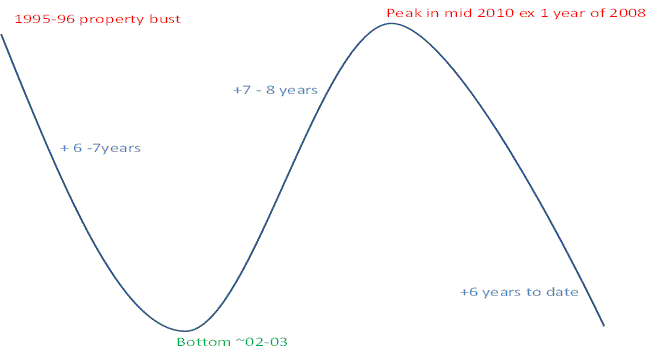
The property cycle in India is long (7 years) and shows strength both in terms of amplitude and the length, either way. Indeed, in the past 20 years there has been one down cycle (1996-2002) wherein RE under performed most investment asset classes, notably CPI. Volume data for the same period isn’t available but evidence suggests it fell sharply. This was followed by a strong upcycle from 2003-2009 which was interfered by 1 year of GFC in 2008, thus carrying the upcycle well into in 2010. Volumes and price both went up manifold in the same period and RE probably outperformed most investment classes.
 It stands to reason that the down cycle that started in mid 2010 is now in its 6th year and 1 year likely away from its end. Strength on the downside again has been extreme with many industry veterans calling it the sharpest / most vicious down turn in history. Prices in many areas are down 10-25% and generally have underperformed CPI.
Rental yields in most markets in affordable housing are near mortgage level (on a post tax basis) – A situation that has not been there in the market since 2003. 97% of the buyers in the market are end users, suggesting investors are all but completely out (as per a Prop Tiger report).
Affordability as defined by Price to Income is one of the highest ever since 2009 across most markets- If one were to factor in the reduction in home loan rates and potentially higher tenure loans along with reduced unit sizes, the house price to mortgage payment ratio is the best since 2009.
Prices in general have lagged CPI and even general salary growth across markets over last 6 years. This likely has led to reduced investment demand but has also probably improved end user economics. We note that 1996-2003 prices also lagged inflation but made up for it in later years. Over a long cycle, property generally delivers inflation + 1-2% return
Developers incrementally aren’t buying land but forming JD / JVs to optimize capital return. Many companies that entered the market in 2006-07 are mostly out and looking to sell land. The earlier cycle has also followed some large profile near bankruptcy cases in the sector.
Rental yields in most markets in affordable housing are near mortgage level (on a post tax basis) – A situation that has not been there in the market since 2003. 97% of the buyers in the market are end users, suggesting investors are all but completely out (as per a Prop Tiger report).
Affordability as defined by Price to Income is one of the highest ever since 2009 across most markets- If one were to factor in the reduction in home loan rates and potentially higher tenure loans along with reduced unit sizes, the house price to mortgage payment ratio is the best since 2009.
Prices in general have lagged CPI and even general salary growth across markets over last 6 years. This likely has led to reduced investment demand but has also probably improved end user economics. We note that 1996-2003 prices also lagged inflation but made up for it in later years. Over a long cycle, property generally delivers inflation + 1-2% return
Developers incrementally aren’t buying land but forming JD / JVs to optimize capital return. Many companies that entered the market in 2006-07 are mostly out and looking to sell land. The earlier cycle has also followed some large profile near bankruptcy cases in the sector.
Saturday, April 23, 2016
Indian REITs - USD 18 bn Opportunity
With the Budget 2016-17 clearing the key hurdle of Dividend Distribution Tax (DDT), it has paved the way for REITs/ InvITs to see the light of day. We expect the 1st REIT/ InvIT listing in CY17.
As per Jones Lang LaSalle, REIT-able Grade A office space totals ~229 msf in India across 727 assets. Conservatively assuming that ~50% of this is REIT-able and an average sub-dollar rent of Rs 70/ psf, it would translate into a USD 18 bn of REIT value creation potential (based on a cap rate of 8% and an exchange rate of Rs 65/ $) Mumbai, NCR and Bangalore collectively account for 2/3rd of REIT-able assets
A number of Joint Venture (JV) platforms have been created recently between PE investors and established developers to invest in Indian commercial real estate.
As per Jones Lang LaSalle, REIT-able Grade A office space totals ~229 msf in India across 727 assets. Conservatively assuming that ~50% of this is REIT-able and an average sub-dollar rent of Rs 70/ psf, it would translate into a USD 18 bn of REIT value creation potential (based on a cap rate of 8% and an exchange rate of Rs 65/ $) Mumbai, NCR and Bangalore collectively account for 2/3rd of REIT-able assets
A number of Joint Venture (JV) platforms have been created recently between PE investors and established developers to invest in Indian commercial real estate.
- Standard Chartered and Tata Realty & Infrastructure to create a Rs 30 bn investment platform, to buy commercial assets across the country. Standard Chartered’s share in this JV to be Rs 20 bn.
- Goldman Sachs and Nitesh Estates announced a 74:26 JV with a commitment of Rs 18.5 bn from the former
- Warburg Pincus and Embassy Group announced to invest USD 175 mn and USD 75 mn respectively in a JV that would focus on building warehouses across the country
Monday, March 07, 2016
Incentives for REITs and affordable housing
The budget was positive for commercial property and affordable housing markets, key highlights being – 1) Dividend Distribution Tax (DDT) exempt in respect of distributions made by the Special Purpose Vehicle (SPV) to the Real Estate Investment Trust (REITs)/Business trust and in the hands of investors; subject to 100% ownership of the SPV; 2) 100% deduction on the profits for developing affordable housing projects for houses up to 30sq mtr (in metros) and upto 60sq mtrs (in other cities) approved during Jun'16 – Mar19 and completed within three years; with minimum alternate tax being applicable; and 3) first-time home buyers to benefit from additional interest deduction of up to Rs50,000 on loan not exceeding Rs3.5mn for a house valuing less than Rs5mn.
We believe the budget has provided the requisite bold tax concessions to promote establishment of Indian REITs, as per our expectations. We think DDT exemption has reduced tax leakage to near 20% (from 35% earlier) largely addressing industry concerns making Indian REITs a relatively tax efficient structure; and comparable with other REIT markets. Tax incentives for construction of affordable housing should resolve
execution/profitability concerns for developers. Further we believe interest concessions for first home buyers could help step-up housing demand
We believe the budget has provided the requisite bold tax concessions to promote establishment of Indian REITs, as per our expectations. We think DDT exemption has reduced tax leakage to near 20% (from 35% earlier) largely addressing industry concerns making Indian REITs a relatively tax efficient structure; and comparable with other REIT markets. Tax incentives for construction of affordable housing should resolve
execution/profitability concerns for developers. Further we believe interest concessions for first home buyers could help step-up housing demand
Thursday, February 25, 2016
Lodha Developers Sales to Touch Billion Dollar
Lodha Developers remains the largest developer in India on pre-sales done per year. Management expects to cross Rs65 bn of sales in FY2016, maximum of which is from the MMR. Focus remains high on deliveries. Lodha has nearly 3,900 employees with 50% of these being technical (engineers, construction management experts). Construction spend has increased from Rs19 bn in FY2013 to nearly Rs24 bn in FY2015. As per the management, Lodha has over 700 engineers, the highest for any developer in India and has the largest Customer Relationship Management (CRM) team of over 300 people. Focus on pre-sales is high, both through in-house and broker channel (over 4,000 brokers empaneled in India).
Lodha Developers & Builders Land Bank
Although total land bank is around 6,000 acres (most of it part of the Palava City development); Lodha wants to remain asset light in land strategy in Mumbai. Most land parcels in Mumbai are acquired in the past five years and already under development.
Business is divided into (a) Development of 4,500 acre Palava City in MMR (Phase-2 of 660 acres under development with Phase-1 of 270 acres delivered), (b) Development of marquee residential projects in upmarket locations (The World Place, The Park in Lower Parel, Mumbai and The Altamount, Altamount Road, Mumbai), (c) Development of premium residential projects across Mumbai suburbs (six projects under-development).
Lodha is also developing select projects in Pune, Hyderabad and London. They also intend to increase focus on commercial (Build-and-lease model) and are planning nearly 6 mn sq. ft of commercial space in Palava City. 0.5mn sq. ft of mall will be operational this year.
Lodha Developers & Builders Land Bank
Although total land bank is around 6,000 acres (most of it part of the Palava City development); Lodha wants to remain asset light in land strategy in Mumbai. Most land parcels in Mumbai are acquired in the past five years and already under development.
Business is divided into (a) Development of 4,500 acre Palava City in MMR (Phase-2 of 660 acres under development with Phase-1 of 270 acres delivered), (b) Development of marquee residential projects in upmarket locations (The World Place, The Park in Lower Parel, Mumbai and The Altamount, Altamount Road, Mumbai), (c) Development of premium residential projects across Mumbai suburbs (six projects under-development).
Lodha is also developing select projects in Pune, Hyderabad and London. They also intend to increase focus on commercial (Build-and-lease model) and are planning nearly 6 mn sq. ft of commercial space in Palava City. 0.5mn sq. ft of mall will be operational this year.
Subscribe to:
Posts (Atom)